Sep 22, 2014
May 17, 2014
Nov 18, 2013
The Glass Beach, Mendocino county, California.
Early in the 20th century, residents of Fort Bragg pitched their household waste, glass, kitchen appliances, and sometimes whole cars, over these cliffs, then owned by Union Lumber Company and known locally as “The Dumps.”
Wilbur Lawson, 83, of the Fort Bragg-Mendocino Coast Historical Society, remembers poking around the junkyard as a kid during the 1930s. “There was always a fire lit in order to reduce the trash pile,” he says, which might explain how that chinaware melded into a slab of solid rock. “This was a playground for us,” he recalls. Despite rumors, he says a glass-bottle factory never existed on this coastline.
By the early sixties, some attempts were made to control what was dumped, and dumping of any toxic items was banned. Finally in 1967, the North Coast Water Quality Board realized what a mistake it was and plans were begun for a new dump away from the ocean.
Now, over 40 years later, Mother Nature has reclaimed this beach. The pounding surf began to heal the shore over the next several decades, wave action have deposited tons of polished glass, grinding the castoffs into the glittering treasure that now covers the beach. Since then, the place has become a beachcombers’ paradise and a living science lesson in one.
Then in 2003 the state bought the 38-acre property for $2.48 million. So now Glass Beach, just south of Pudding Creek, is part of MacKerricher State Park.
The park brochure warns that “it is illegal to remove or harm plants, animals or other natural features.”
A secret beach lures visitors in the know to Fort Bragg, an unpretentious town in Northern California. So much sea glass smothers this hidden shoreline that you might think a truck unloaded shimmering shards all over its rocky coves, and that’s not too far from the truth.
Only a dirt path indicates that the end of the rainbow lies beyond.
Shimmy down to the shore’s edge. Before long, you’ll be standing on it like a leprechaun on a pile of gold coins, dancing a little jig. Emerald, ocher, amber, and ruby bits of ground glass sparkle beneath your feet and in the tumbling tide, where years of surf have polished them to a muffled shine. A handful of the stuff might reveal a kaleidoscope of shapes and colors, but also some seaweed, rusty metal pieces and a spark plug or two. What is now called Glass Beach, began as this city’s garbage dump.
Wilbur Lawson, 83, of the Fort Bragg-Mendocino Coast Historical Society, remembers poking around the junkyard as a kid during the 1930s. “There was always a fire lit in order to reduce the trash pile,” he says, which might explain how that chinaware melded into a slab of solid rock. “This was a playground for us,” he recalls. Despite rumors, he says a glass-bottle factory never existed on this coastline.
Now, over 40 years later, Mother Nature has reclaimed this beach. The pounding surf began to heal the shore over the next several decades, wave action have deposited tons of polished glass, grinding the castoffs into the glittering treasure that now covers the beach. Since then, the place has become a beachcombers’ paradise and a living science lesson in one.
Then in 2003 the state bought the 38-acre property for $2.48 million. So now Glass Beach, just south of Pudding Creek, is part of MacKerricher State Park.
The park brochure warns that “it is illegal to remove or harm plants, animals or other natural features.”
A secret beach lures visitors in the know to Fort Bragg, an unpretentious town in Northern California. So much sea glass smothers this hidden shoreline that you might think a truck unloaded shimmering shards all over its rocky coves, and that’s not too far from the truth.
Only a dirt path indicates that the end of the rainbow lies beyond.
Shimmy down to the shore’s edge. Before long, you’ll be standing on it like a leprechaun on a pile of gold coins, dancing a little jig. Emerald, ocher, amber, and ruby bits of ground glass sparkle beneath your feet and in the tumbling tide, where years of surf have polished them to a muffled shine. A handful of the stuff might reveal a kaleidoscope of shapes and colors, but also some seaweed, rusty metal pieces and a spark plug or two. What is now called Glass Beach, began as this city’s garbage dump.
Oct 25, 2013
El Diablo – The Volcanic Restaurant of Lanzarote
DO U WANT TO HAVE A TASTY FOOD ON TOP OF A VOLCANO...?
El Diablo – The Volcanic Restaurant of Lanzarote
Located on a Spanish island called Lanzarote, northwest of Morocco, El Diablo is a unique
restaurant where the chefs have access to a volcano of their own.Patrons can choose from a variety of meat and fish dishes barbecued on a grill heated to between 450 to 500 degrees Celsius using geothermal heat from the volcano..
Building a restaurant on top of a massive heat source is not a easiest task.
in 1970, Cesar Manrique decided to create a formal restaurant in the area. Thus, with the help of architects Eduardo Caceres and Jesus Soto, a giant grill was built on the ground that makes use of the immense heat below the Earth’s surface. And that’s how El Diablo was born..
Oct 22, 2013
The 800 years old Avenue of the Baobabs ..
The Avenue of the Baobabs or the Alley of Baobabs, is located in the sides of the road between Morondava and Belon'i Tsiribihina in the Menabe. Menabe is a area in western Madagascar. Baobab trees, up to 800 years old, Baobab trees, up to 800 years old, The trees are a heritage of the deep tropical forests that once thrived and grew on Madagascar. Baobabs did not really tower in isolation over the dry landscape but stood in dense forest. Over the years, population grew on the country, the forests were cleared for agriculture, leaving only the baobab trees. Baobabs store water in the trunk up to 100,000 liters or 26,000 US gallons to bear the heat and dry conditions. All happen in seasonally dry areas, shedding their leaves in the dry season.
Its beautiful landscape attracts travelers from all over the world, making it one of the most Beautiful locations that must be visited .
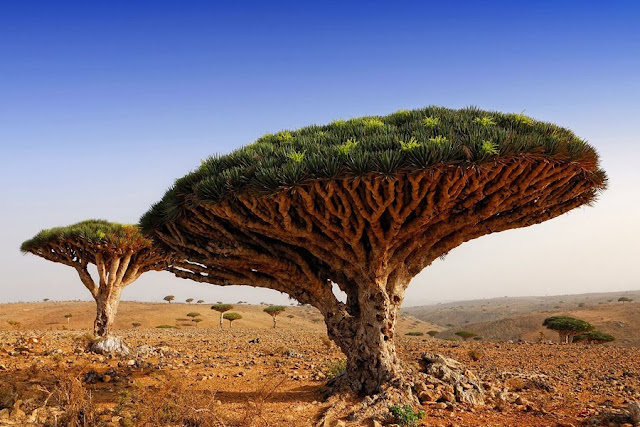
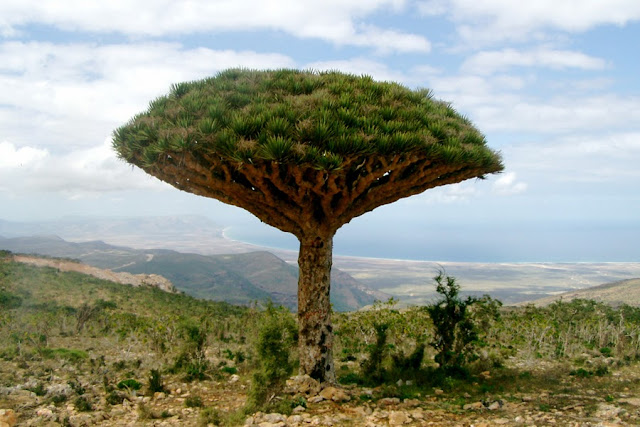
Dragon Blood Tree
Dragon Tree, Discovered in western Morocco.
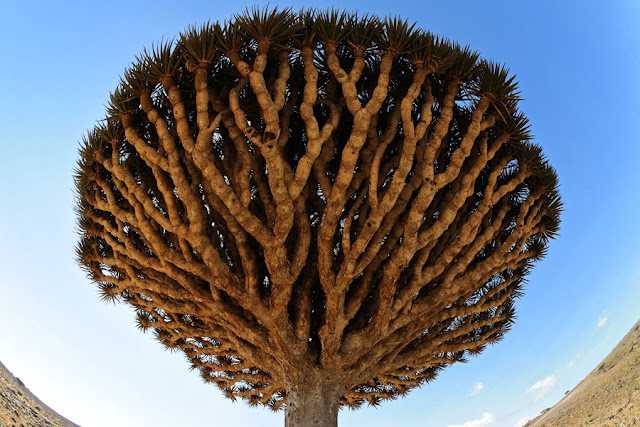
Dracaena cinnabari, the Socotra Dragon Tree or Dragon Blood Tree, is a Dragon Tree native to the Socotra archipelago in the Indian Ocean. It is so called due to the red sap that the trees produce.
The unusual shape of the dragon's blood tree is an adaptation for survival in too dry conditions with low amounts of soil, such as in mountaintops. The large, packed crown provides shade and reduces evaporation. This shade also aids in the survival of seedlings growing beneath the adult tree, explaining why the trees tend to grow closer together.
The dragon's blood tree produces flowers in February month, The flowers tend to grow at the end of the branches. The flowers have inflorescences, and they bear small clusters of fragrant, white or green flowers. The fruits take five months to completely mature. The fruits are described as a fleshy berry, which changes from green to black as it gradually ripens. The fleshy berry fruit ends up being an orange-red color that contains one to three seeds. The berries are usually eaten and dispersed by birds and other animals.
Oct 8, 2013
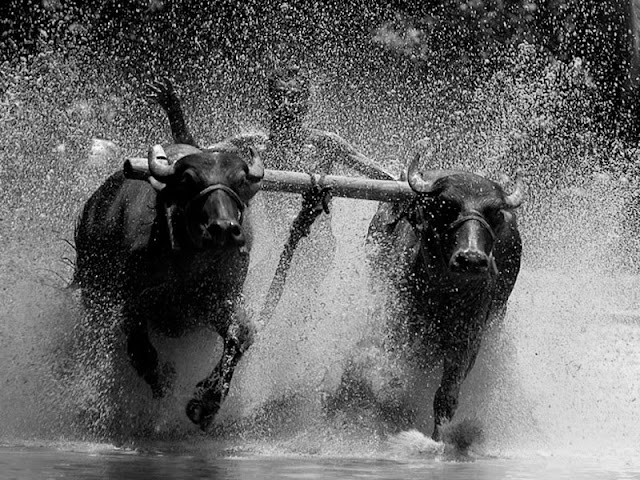
Bull Surfing Sport Kerala,Tamilnadu
Bull Surfing Sport India ..
At the annual Maramadi festival during the post harvest season in the villages of Kerala in southern India, a peculiar bull race takes place. A pair of bulls are sent charging down the football field-sized rice paddy field soaked in ankle deep water, while their guides hang onto the tail or onto a harness and slide through the mud. The fields are freshly ploughed and the muddy water splash about as the bulls are raced by their guides. The villagers gather around these fields keeping safe distance. The air is rent with excitement fervor as there is stiff competition over these races.


Jan 5, 2013
Subscribe to:
Posts (Atom)